
WorkSafeBC for Subcontractors: Registration, CUs, Prime Rule
When you have to register, how Classification Units set your rate, when a sub is actually an employee under WCB, and how prime contractor designation moves liability.
WorkSafeBC for BC subcontractors — registration, Classification Units, the prime contractor rule, and the worker-vs-sub test that catches everyone.
It's Tuesday morning. The general contractor pulls you aside at the jobsite and asks for your WorkSafeBC clearance letter before you can keep working. You don't have one. You're not sure if you needed one. Your status as a "sub" or an "employee" of the GC is suddenly the question that decides whether you keep the job — and whether you owe back-premiums for the months you've been on site.
This post covers WorkSafeBC for subcontractors in BC — when you have to register, how Classification Units assign your premium rate, when a "sub" is really an "employee" under WCB rules (separate from the CRA's test), and how the prime contractor rule allocates safety responsibility across multi-employer worksites.
Key takeaways
WorkSafeBC operates separately from the federal CRA. You can be a "subcontractor" for CRA purposes (filing a T2125 self-employment return) and an "employee" for WorkSafeBC purposes — they apply different tests and the conclusions can differ.
Most BC trade subcontractors must register with WorkSafeBC as employers if they have helpers, OR opt into Personal Optional Protection (POP) if they're sole operators in covered industries.
Your Classification Unit (CU) determines your premium rate per $100 of assessable payroll. The CU is industry-specific: roofing rates are high ($5-$10+), framing/carpentry mid-range ($2-$5), specialty trades (electrical, plumbing, HVAC) often lower ($1-$3).
The prime contractor rule (BC OHS Regulation) requires a designated prime contractor on every multi-employer worksite. The prime contractor coordinates safety for all employers on site — and bears regulatory responsibility for failures.
Clearance letters are how GCs verify your WCB account is in good standing. No clearance letter, no work — most GCs won't let a sub through the gate without one.
The rule, in one sentence
Under the BC Workers Compensation Act and the Occupational Health and Safety Regulation, every BC employer in a covered industry must register with WorkSafeBC, pay premiums based on their classification, and provide a safe workplace; every multi-employer site must have a designated prime contractor coordinating safety across employers. Subcontractors are either employers in their own right (if they have workers), independent operators in covered industries (eligible for POP), or — under specific facts — workers of the payor treated as the GC's employees regardless of how they're invoiced.
The fight is over which category you fall into, and how the prime contractor designation moves liability across the site.
Who is required to register
Three buckets:
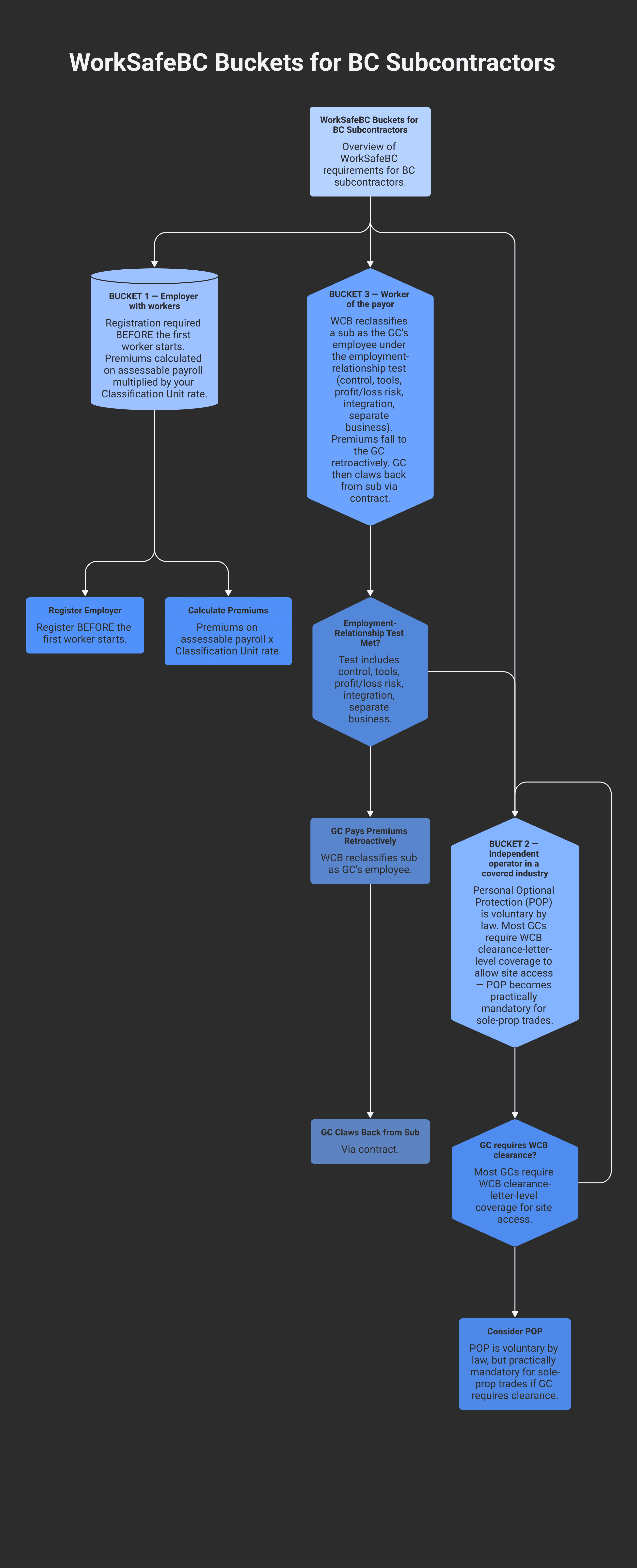
Bucket 1: Employer with workers
If you have any workers (employees, T4-paid helpers, or workers the WCB considers your employees), you must register with WorkSafeBC as an employer. Registration is required before the first worker starts. Premium is based on assessable payroll × your Classification Unit rate.
Bucket 2: Independent operator in a covered industry
A sole-operator subcontractor (no workers) in a covered industry can opt into Personal Optional Protection (POP) — voluntary WCB coverage on yourself. Construction trades are almost all in covered industries. POP isn't required; many sole-prop subs skip it. But most GCs won't let you on site without WCB coverage of some kind, which forces POP for sole operators.
Bucket 3: Worker of the payor
If WorkSafeBC determines that a "sub" is actually a worker under their employment relationship test, the payor (GC) becomes responsible for premiums on that work, retroactively. WorkSafeBC's test for employment is distinct from the CRA's test — and applies similar but not identical factors:
Who controls the work
Who provides tools and materials
The worker's chance of profit and risk of loss
Whether the worker is integrated into the payor's business
Whether the worker has a separate business of their own (other clients, own business name, own equipment)
A subcontractor working primarily for one GC, on the GC's schedule, with the GC's tools, with no other clients, may be reclassified as a worker on a WorkSafeBC audit. The premiums fall to the GC, but the GC then claws back against the sub through the contract.
The takeaway: WCB classifies based on the work relationship, not the invoicing label.
How Classification Units assign your premium rate
WorkSafeBC publishes annual rate tables grouping industries into hundreds of Classification Units. Each CU has a base rate per $100 of assessable payroll, set by the historical claims experience of that industry.
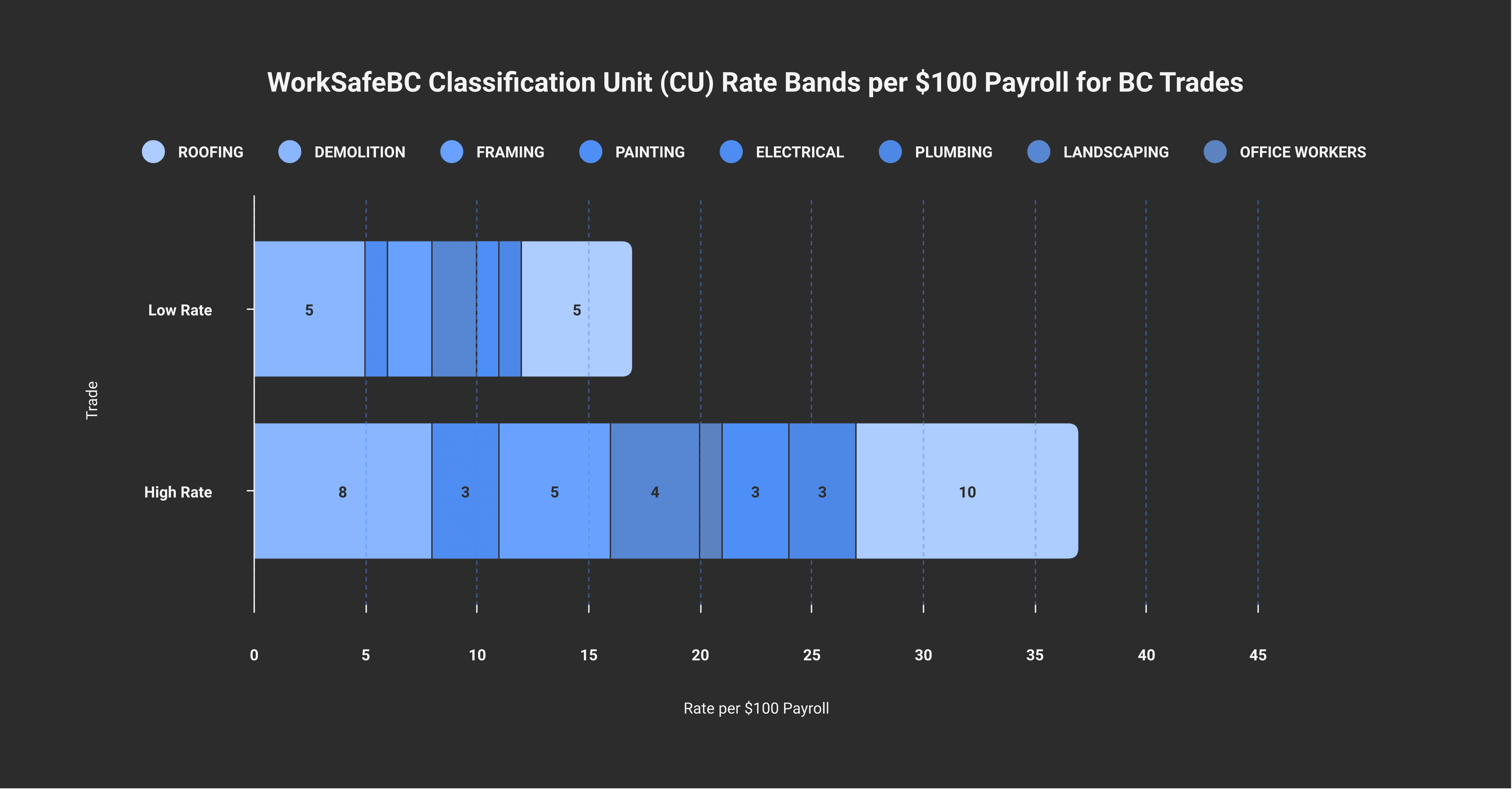
Typical 2026 base rates (illustrative bands — actual rates published annually by WorkSafeBC):
Roofing — typically $5 to $10+ per $100 of payroll. Injury frequency is high.
Demolition — often $5 to $8.
Framing / general construction — typically $2 to $5.
Painting and finishing — typically $1 to $3.
Electrical — typically $1 to $3.
Plumbing and HVAC — typically $1 to $3.
Landscaping — typically $2 to $4.
Office workers (a separate CU even for trade businesses with office staff) — typically under $1.
If you run a trade business with multiple types of work, you typically pay the CU rate for the highest-rate work the business does, unless you can demonstrate clean separation between the activities and assign payroll appropriately.
Experience-rated adjustments can raise or lower your effective rate above or below the base. Claims history matters — a clean 3-5 year claims record can reduce your effective rate; one or more serious claims can push it up. (Modern Axis bookkeeping basics covers the underlying records WCB looks at when running an audit.)
Clearance letters and why they matter on every site
A clearance letter is a WorkSafeBC document confirming that your WCB account is in good standing — registered, premiums up to date, no outstanding compliance issues. GCs require a clearance letter before letting a sub on site for two reasons:
Their own liability protection. If a sub without WCB coverage gets injured on the GC's site, the WCB can pursue the GC for premiums and the injured sub can pursue the GC for damages under the common law.
WCB compliance. GCs designated as prime contractor have a regulatory duty to verify WCB compliance for all on-site employers. The clearance letter is the documentation that closes that duty.
Clearance letters are free, instant to obtain through WorkSafeBC's online portal once your account is current, and need to be refreshed periodically (the letter shows the date the clearance is valid; many GCs require a current-month letter).
No clearance letter often means no work. Many small subs find this out the hard way on their first GC engagement.
The prime contractor rule
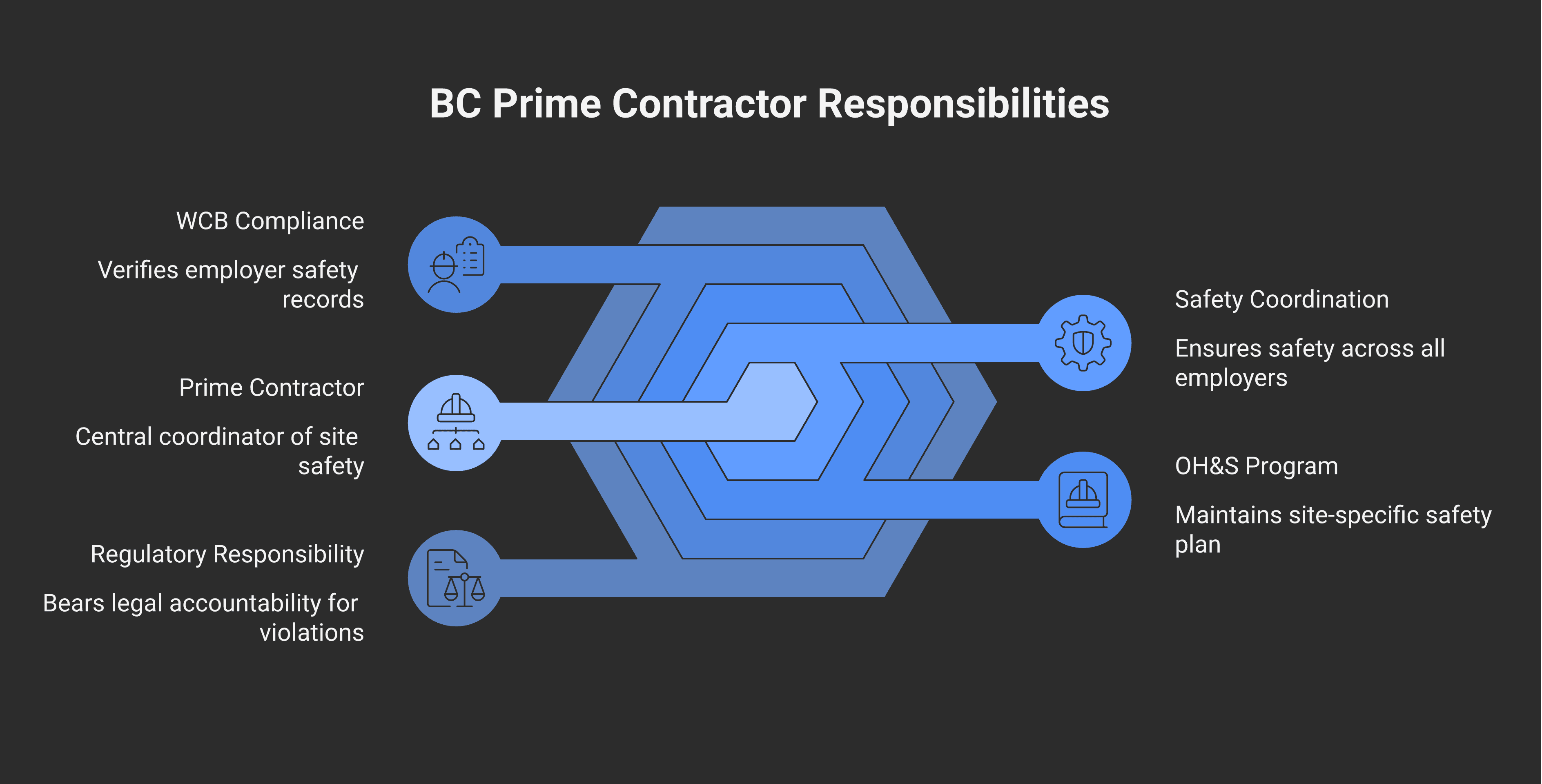
Under the BC OHS Regulation, a prime contractor must be designated on every multi-employer worksite. The prime contractor's role:
Coordinate safety across all employers on site
Maintain a site-specific OH&S program
Ensure WCB compliance for all on-site employers (clearance letters, safety training, equipment certifications)
Bear regulatory responsibility for serious safety violations on the site
For typical commercial or residential construction, the GC is usually designated prime contractor. The designation is in writing in the contract or in a separate prime contractor designation document.
An incorporated subcontractor can be designated prime contractor for a defined scope of work — particularly when the sub leads a multi-trade portion of the build (e.g., a drywall sub overseeing taping, sanding, and finishing crews; a mechanical sub coordinating plumbing and HVAC installers). When this happens:
Your corporation absorbs site-safety coordination responsibility for that scope
Your corporation can face WCB penalties for failures within that scope
Your directors (you) can face personal exposure under the OHS Regulation for serious violations
This rule didn't exist for sole-prop subs in the same way. Worth understanding before incorporating, and worth confirming in writing on every project where the prime contractor designation might fall on you. (CTH's incorporation post covers the broader structural implications.)
When you hire helpers — the "worker" question
A trade contractor who occasionally brings on a helper (paid in cash, no T4, no paperwork) is in WCB's most-audited zone. Three options for legally engaging a helper:
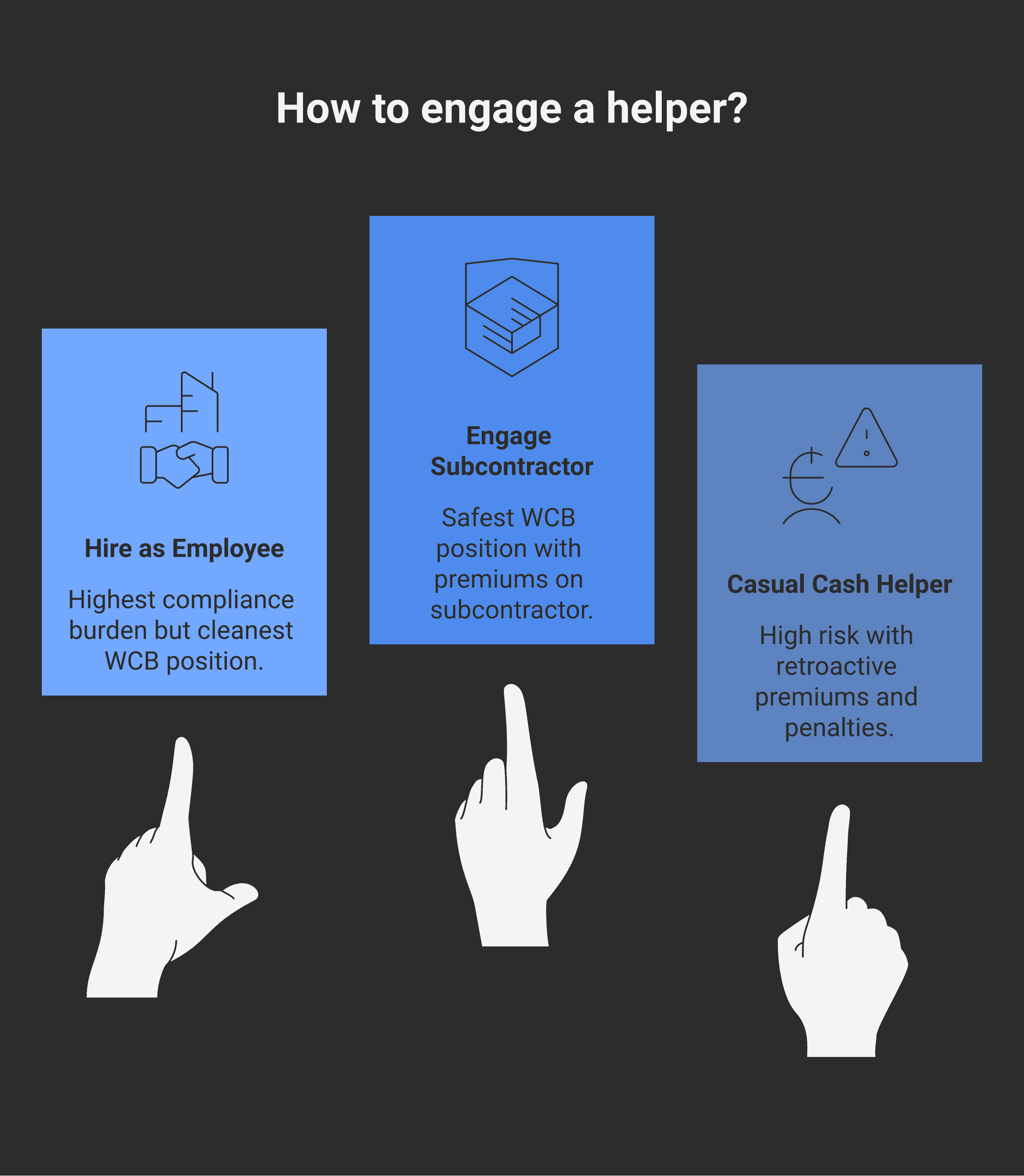
Option A: Hire as an employee
T4 the helper, pay source deductions (CPP, EI, income tax — see our source deductions guide for the broader framework around CRA payroll), register with WCB as an employer (or update existing registration), and pay premiums on the helper's assessable wages. Highest compliance burden but cleanest WCB position.
Option B: Engage a registered subcontractor
The helper is themselves a registered WCB employer (POP-covered sole prop or fully registered employer with own workers). You request and verify their clearance letter every project. Their premiums are on them, not on you. Safest WCB position.
Option C: Engage a non-registered "casual helper"
Pay them cash, don't issue a T4. High risk. WCB will treat the helper as your worker on any audit. Premiums fall to you retroactively, with penalties. CRA may reclassify the relationship and pursue source deductions. Don't do this.
The integration factor isn't optional. If you bring helpers, set them up properly before they show up.
When the WCB administration lands on Contractor Tax Hub
Contractor Tax Hub handles WorkSafeBC registration, quarterly remittances, clearance letter generation, and CU classification review as part of every monthly bookkeeping engagement. For incorporated trades with multiple employees or holdco structures, Modern Axis CPA's comprehensive accounting service coordinates with WCB filings on the broader picture. If you're a sole prop deciding between POP and full registration, or an incorporated sub negotiating prime contractor designation on a complex job, the Growth or Premium packages cover the strategic and administrative work together.
Frequently asked questions
Do I have to register with WorkSafeBC as a subcontractor?
If you have any workers (employees or T4-paid helpers), yes — registration is required before the first worker starts. If you're a sole operator in a covered industry (which includes virtually all trades), registration isn't required by law, but most GCs require clearance-letter-level WCB coverage to let you on site. The practical answer for sole-prop trades: opt into Personal Optional Protection (POP).
What's a Classification Unit?
A Classification Unit (CU) is the industry-specific category WorkSafeBC uses to assign your base premium rate per $100 of assessable payroll. CUs reflect historical claims experience of each industry. Roofing CUs run $5-$10+ per $100; framing/general construction $2-$5; specialty trades like electrical/plumbing/HVAC often $1-$3. Experience-rated adjustments can raise or lower your effective rate based on your own claims history.
What's the prime contractor rule?
Under the BC OHS Regulation, every multi-employer worksite must have a designated prime contractor responsible for coordinating safety across all employers on site, maintaining the site OH&S program, and verifying WCB compliance for all employers. GCs are usually prime contractor; incorporated subs can be designated for specific scopes of work. The designation carries regulatory responsibility for safety failures.
What's a clearance letter?
A clearance letter is a WorkSafeBC document confirming that your account is in good standing — registered, premiums current, no outstanding compliance issues. It's the documentation GCs require before letting subs on site. Letters are free, generated instantly through the WorkSafeBC online portal, and need to be refreshed periodically (typically monthly).
What happens if I hire a helper without registering?
WCB will treat the helper as your worker on any audit. Premiums fall to you retroactively (often 1-3 years of back-premiums), with penalties. The CRA may also reclassify the relationship and pursue source deductions. The compliance cost of doing it right (T4 the helper, register with WCB, pay premiums) is dramatically lower than the cleanup cost when caught.
How does WCB decide if a "sub" is actually an employee?
WorkSafeBC applies an employment relationship test — similar to the CRA's test but not identical. Factors weighed: control over the work, ownership of tools/materials, the worker's chance of profit and risk of loss, integration into the payor's business, whether the worker has a separate business of their own (other clients, own equipment, own business name). A sub working primarily for one GC, on the GC's schedule, with the GC's tools, with no other clients, can be reclassified.
Can my incorporated business be designated prime contractor?
Yes, if the GC designates your corporation as prime contractor for a defined scope of work — typically when you lead a multi-trade portion of the build. Once designated, your corp absorbs site-safety coordination responsibility for that scope, can face WCB penalties for failures within it, and directors (you) can face personal exposure under the OHS Regulation for serious violations.
What if the GC tells me they'll cover me under their WCB account?
Verify in writing. Some GCs do extend coverage to their direct subs in specific arrangements, but this is the exception and requires explicit documentation. Most GCs require subs to have their own WCB coverage and clearance letters. If a GC tells you verbally that you're "covered under them," get it in writing or assume you're not — the consequences of being wrong are entirely on you.
This is a general overview of how WorkSafeBC rules work for Canadian subcontractors in BC, not advice for your business. CU rate assignments, prime contractor designations, and the WCB employment-relationship test all turn on facts not covered above. Contractor Tax Hub can review your specific WCB position — but don't rely on a blog post in place of professional review.